
This post might generate some discussion. I hope so. The topic needs to be discussed, since so much of what we talk about in the church tends to be assumptive about what the church is created to be, and I think asking the question of the church’s purpose is an important one.

What has led me to raise this subject is reading CT editor, Mark Galli’s recent article, “The Church’s Sickness Unto Death.” In it he argues that the problem evangelicalism has had in recent decades in trying to move the church towards being more missional (with limited success) is that, “The church, from the start, has not actually been designed to be missional.” In fact, “when the church is conceived primarily as being missional, existing for the sake of the world,” Galli states, it leads to it becoming ineffective both in discipleship and worship, on the one hand, and in evangelism and social justice issues on the other.
The church, from the start, has not actually been designed to be missional.
Mark Galli
In short, the church was never really designed to do both, and Galli opts for the church as primarily being designed to help form believers into disciples, rather than an institution for social change. To be clear, it is not as if Galli is against social justice involvement or evangelistic endeavours. But he believes that parachurch organizations are better suited to be effective in those types of mission (and that Christians should involve themselves in such organizations as a matter of faithful discipleship). So, Galli’s model might look something like the image below that I pilfered from the internet.

This challenge to the missional focus so oft repeated in church circles these days will strike some as simply wrong-headed. What could be more intuitively obvious than the church existing to transform the world? For Pentecostals (my tribe), who emphasize the church’s call to be witnesses for Jesus (Acts 1:8), Galli’s words might be viewed as a sign of losing spiritual zeal for evangelism.

But before rushing to rash judgments, let’s take a step back and ask some important questions. And to be honest, in the discussion that follows, I’m not quite sure where I’ve quite landed on this issue. But I do know this: the matter of the design and purpose of the church is not a simple matter, and it is fairly easy to import North American pragmatism into our interpretation of Scripture, leading us to assume certain views of how mission should be accomplished are just obviously true. They are not; and we are required to give this more thought.
What I want to do, briefly, is show that Galli’s questions are not bizarre, or outside of a Pentecostal approach to church mission. So, in what follows, I’ll leave Galli behind and focus on the contributions of Simon Chan, a Classical Pentecostal theologian, who teaches in Singapore. In particular, his 2006 book, Liturgical Theology directly addresses the issues Galli is raising.
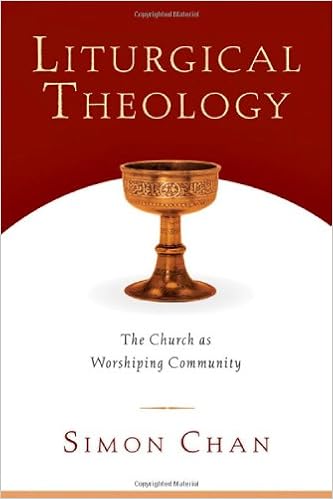
First, Chan strongly echoes Galli’s proposal that it is wrong to view the church as existing for the sake of the world. Chan puts it this way. We basically have two options theologically when it comes to understanding the church: either the church has been formed for the sake of the creation, or creation has been formed for the sake of the church. Get this wrong, and you will get everything else wrong about the purpose of the church.
Chan uses N.T. Wright as his foil (which causes me pause, because I really like Wright!). Wright takes the church-exists-for-creation approach, whereas Chan advocates for the creation-exists-for-the-church approach. Whereas Wright accents the Genesis creation story, Chan focuses on Paul’s broad scope summary of the purpose of the church in Ephesians. From Paul’s perspective, he argues, creation is formed in order that there would one day be a people of God (body or Christ, temple of the Spirit, etc.). Creation is important (and certainly not to be abused), but it is primarily the physical framework necessary for the church to be brought into existence. So, creation will continue (eventually as new creation), so that the church can continue eternally as well.

This creation-for-church model, Chan argues, has always been God’s plan. To reverse the order makes the church into a temporary organization to help get creation back to where it should be. And, if the church isn’t doing this very well, then why not just join some other social justice organization? Pushed to it’s extreme, the church becomes just one of any number of social agencies, and perhaps even superfluous to God’s work in the world.
Now, I’m sure Wright would have a good response to this, since he is far more committed to the institutional church than the average North American evangelical. But I don’t want to go down the road of investigating Wright position. For my purposes, I think Chan has identified something very important, and something probably embedded into the assumptions of North American Pentecostals and broader evangelicalism. And it’s something we might never think to ask: does the church exist for creation, or creation for the church? How we answer this will determine our local church priorities.

To clear up some potential misunderstandings, firstly, Chan is not saying that the world should serve the church. He is not seeking some form of return to Christendom, if I’m reading him correctly. He is only identifying the theological purpose (telos) of the church: creation was formed so that God could have relationship with a created people for himself in and through his Son, Jesus–the church.
Secondly, Chan is not saying that Christians should not do good in the world. Of course they should, and why wouldn’t they? This should be part of Christlikeness being lived out in daily life. So too, Christians should be involved in witness through evangelism. All believers should be prayerful about how to involve themselves in meaningful ways in the brokenness of society in all manner of ways. But the priority of the church corporate is to worship and form disciples, and in doing that, the church bears faithful witness to Jesus. To not do this means being a less-than-faithful witness.

This last point is worth a bit more explanation. It is often assumed that worship and discipleship is something other than witness, the latter being viewed as the activity of explicit evangelism. But in Chan’s view, the church is being a witness only insofar as it is truly representing the Trinity in the world as clearly as possible. The image of God is formed in God’s people through regular participation in thoughtful, intentional, theologically robust corporate liturgy. Worship and discipleship are inseparable for Chan, and only in being formed as the people of God does the church truly fulfill its call to bear witness in the power of the Spirit. And remember, Chan is a Classical Pentecostal.

So, in sum, the church is called missionally to bear witness to the triune God by becoming formed as worshiping disciples more and more into the likeness of Jesus. I think this more or less summarizes key points in Chan’s view, and I think this is close to what Galli is getting at in his article. So, Pentecostals cannot simply dismiss Galli as ignoring the Christian vocation of witness; he is not. And in Chan we have at least one Pentecostal voice saying something remarkably similar.
The question is now in our court, and again, I’m not quite sure where I land on this one. How do you see the purpose of the church: church-for-creation or creation-for-church? And what theological support do you have for your position? Let the conversation begin!
For more on Chan’s theology, see Ch.4 of my book, Pentecostal Experience: An Ecumenical Conversation.
 Peter D. Neumann
I find the term ‘tribe’ to be unpalatable. The very term suggests who is in the tribe and who is one the outside….Jesus was all about bringing those on the ‘outside’ into the inside, to be included.
If the church’s mission is to convert people, than we’ve missed the mark completely.
The message of Christ was much much bigger than this.
Thanks Dwayne. My use of “tribe” here wasn’t in reference to Christianity, but to Pentecostalism. I was simply using the term as a casual way of refering to the tradition in which I find myself. It wasn’t intended to designate that some would not be welcome to follow Jesus. On the other hand, I think I’d want to preserve some definitions for the sake of being able to communicate meaning between people. So, in that sense I’m ok with identifying groups, while acknowledging that the boundaries are more fuzzy than we might perceive or want to allow.
As for conversion, if it is not within the mandate of Christians to convert people, then how would you deal with Jesus’ commission to make disciples (Mt 28) or be witnesses globally (Acts)? Maybe it’s the word, “convert” that is making you hesitant? I’d love to hear more. Thanks again!
Hi Peter,
Creation-for-church is my view.
Jesus gave us two commandments, the first one is to love God, and the second is to love our neighbour. In my perspective creation-for-church is putting the first commandment first. We were created to worship God first and foremost.
I can understand the church-for-creation theory being that Jesus did come into the world as our Saviour. And as the church we are to evangelize with love. I think this is putting the second commandment first. Reversing the order of Jesus’ commands. Hence my view on creation-for-church.
I agree with Chan’s view, “…the church is being a witness only insofar as it is truly representing the Trinity in the world as clearly as possible. The image of God is formed in God’s people through regular participation in thoughtful, intentional, theologically robust corporate liturgy.”
We were created to become the church and with God being our source of love through corporate worship we can then become the church that helps creation.
I also agree with Mark Galli. I think there is an imbalance of corporate worship and evangelism. Neighbourly love goes awry and the love for God grows cold without enough corporate worship. And corporate worship alone without evangelism is missing Jesus’ second command.
In my understanding, it is creation-for-church because of Jesus’ two commandments. We are created to love God
Good thoughts! Thanks Joanne!