Navigating through Doctrinal Change: A Guide for the Perplexed, Pt. 4

Now we come to the final tip in this series. To recap, during times of doctrinal change and uncertainty our inner and social worlds may feel considerably destabilized. This uncertainty is due to the multifarious opinions on pretty much all theological matters online, in books, podcasts, webinars, and so forth. And even more personally, for me, this uncertainty is intensified because my denomination, the PAOC, is undergoing a “doctrinal refresh,” and rewriting its doctrinal articulation, its Statement of Fundamental and Essential Truths (SOFET).

Photo by Anete Lusina on Pexels.com

The full SOFET revision in scheduled come to the General Conference floor for some sort of decision in 2020. So, approaching this event, I thought it might be helpful to process not the specific content of PAOC doctrinal beliefs, but instead how we process our beliefs in general. Understanding this will provide a framework for decision-making when it comes to doctrinal decision-making. Let me also state here that the points in this blog series are not intended to be applied only to PAOC contexts. I’m really trying to outline a helpful way for Christians of all stripes to think about their beliefs.

To this point I’ve recommended two tips in my previous blogs in this series: 1) Don’t panic (dealing with the psychological impact of challenges to our beliefs), and 2) Be humble when it comes to what we think we can know, and be ok with some level of uncertainty.

Now we come to the final tip.

Tip 3: Accept that there are Levels of Theological Truth (not all “fundamental and essential truths” are necessarily fundamental or essential for Christian faith)

Off the bat this might look like I’m challenging the title of the PAOC’s SOFET, but that’s not really my goal here (I can live with the title). The challenge is that the SOFET contains doctrines that are neither fundamental nor essential to Christian faith. This doesn’t mean these are not important doctrines (especially if one intends to hold credentials with the PAOC); it simply means that one can be a faithful Christian without believing every single one of these doctrines. Some of the doctrines are more fundamental and essential than others.

The point is this: There are levels of theological truth, and we need to accept this to function well not only in times of doctrinal refreshes and disputes, but throughout life in general, if we hope to grow in maturity in Christian faith and to avoid psychologically injuring ourselves personally and corporately by living in a state of over-protective hyper-vigilance.

Photo by Lukas on Pexels.com

Lest this seem to be my opinion alone, I’m happy that this very point was made publicly by a member of the SOFET committee during a presentation at the PAOC General Conference earlier this year (May 2018). One goal of the SOFET refresh in part is to help better focus the content on what is really fundamental and essential, giving less emphasis to what might be less central. There was no dispute raised on the floor to this idea, and so I will take this silence as tacit consent to the general point I’m making here 😊.

To appreciate this, we need to better understand how we tend to hold beliefs mentally.

A Common Belief Model: The House of Cards
One of the most helpful illustrations regarding how we tend to hold beliefs comes from Gregory Boyd’s, The Benefit of the Doubt. He proposes two models for how we hold our beliefs psychologically: a house of cards and concentric circles.

The house of cards model refers to the pastime of building a “house” using playing cards by leaning one card up against another. By progressively adding cards, an impressive structure can be erected. Provided that all the cards remain in place, one can continue to add to the structure, making it ever more complex. But the very method of construction is also the inherent weakness of this house. Every card relies on all the others for its stability. Remove one card and the entire house collapses.

Boyd says that often Christians hold their beliefs in a similar way. This is often due to what I addressed in my second tip (part 3 of this blog series), that we may have learned to take all teaching we have received from pastors and Christian leaders as absolute truth. All of it. And when we do this, we begin to feel that each of these “truths” bears equal importance. No one likely asserts this explicitly, but it becomes a psychological reality. Each “truth” functions like a card in the overall doctrinal house of cards. Each conviction is so emotionally connected to the others that each comes to bear almost equal weight. We feel it deeply because we’ve learned to do so. And when all the beliefs are in place, we feel safe within the walls of our cozy card-house fortress.

This does imply, however, that each card in our fortress needs to be protected as if our life of faith depended on it. For if even one belief is doubted, or turns out to be untrue, the entire mental structure is jeopardized, and this can easily lead to a crisis of faith.
For example, we might happen to discover, despite what our pastor perhaps strongly preached, that the evidence for a pre-tribulation rapture in Scripture is not so blatantly obvious as we supposed in contrast to other timing-of-the-rapture theories (or even more unsettling, that there might be far less scriptural evidence for a two-stage return of Jesus than assumed in dispensationalist systems!). Now, please know that this paragraph is not intended to open the door for a debate on eschatology and Left Behind novels—that’s not the point. The example above is only intended here for hypothetical illustration. The point is that if one becomes less sure about something they were told was very true, and they find out it isn’t necessarily as true (or maybe outright false), and if that doctrine was promoted as being of great importance (such that to not believe it would make your commitment to Jesus or at least the church community suspect), then this does open to door to wondering what else you were taught that doesn’t have quite the scriptural backing you thought. And this, I believe, is the place many faithful Christians are in today.

In the house of cards model, once one conviction is weakened the entire structure is threatened. When one doctrine is removed, the edifice collapses.

How the House of Cards Model Affects Us

How does this affect those holding this model, practically? I will stereotype here for convenience, but this I think the following is fairly accurate.

Personally, holding this model has the advantage of providing a feeling of assurance and confidence; at least most of the time. And this feeling feels so good. However, it also comes with potential anxiety over losing this feeling by being exposed to new information or ideas that do not fit within the card house, and so one needs to be vigilant to spot any maverick theology that might threaten the safety of the card fort. Theology in this view is often assumed to be a fixed discipline; theology is something figured out by theologians about 500 years ago or so (in Protestant traditions and their offspring). Currently, all we need to do is package theology in new ways to ensure cultural relevance. The content doesn’t (should not!) change, and so all that’s required is be reminded from time to time of what we believe (i.e., what has been resolved once and for all), and then market this content better (or not). But any revisions to theology are considered threatening in this model because they are considered a movement away from a static deposit of truth. So, personally opening oneself to, say, new scientific discoveries, or alternative Christian viewpoints on any number of matters is by default a move away from truth and toward a potential collapse of faith. Openness to knowledge from outside the doctrinal system is often considered too risky, and so one avoids listening to other than what one has been taught.

Socially, this model does connect people in strong ways, provided they all agree on pretty much everything. But this requires a hyper-vigilance among those in the particular church community. One must not only constantly evaluate oneself, but also others to determine whether they are in or out of, or poses a danger to, the house of cards. Public expression of doubts, questions, or alternative ideas is discouraged on threat social exclusion (or at least not being quite “trusted,” which removes leadership opportunities). Theologically, this model can encourage debates concerning non-essential theological matters, since there are (almost) no non-essential theological matters! Such communities are ripe breeding grounds for judgmentalism and theological witch-hunting.

Although there are positives—feeling certain and being strongly connected to like-minded others—the house of cards model is not sufficiently flexible for mature Christian faith. The world is more complex than this model allows, and it fails to acknowledge that humans can continue to grow in knowledge of God and the universe. Another model is needed.

A Better Belief Model: Boyd’s Concentric Circles

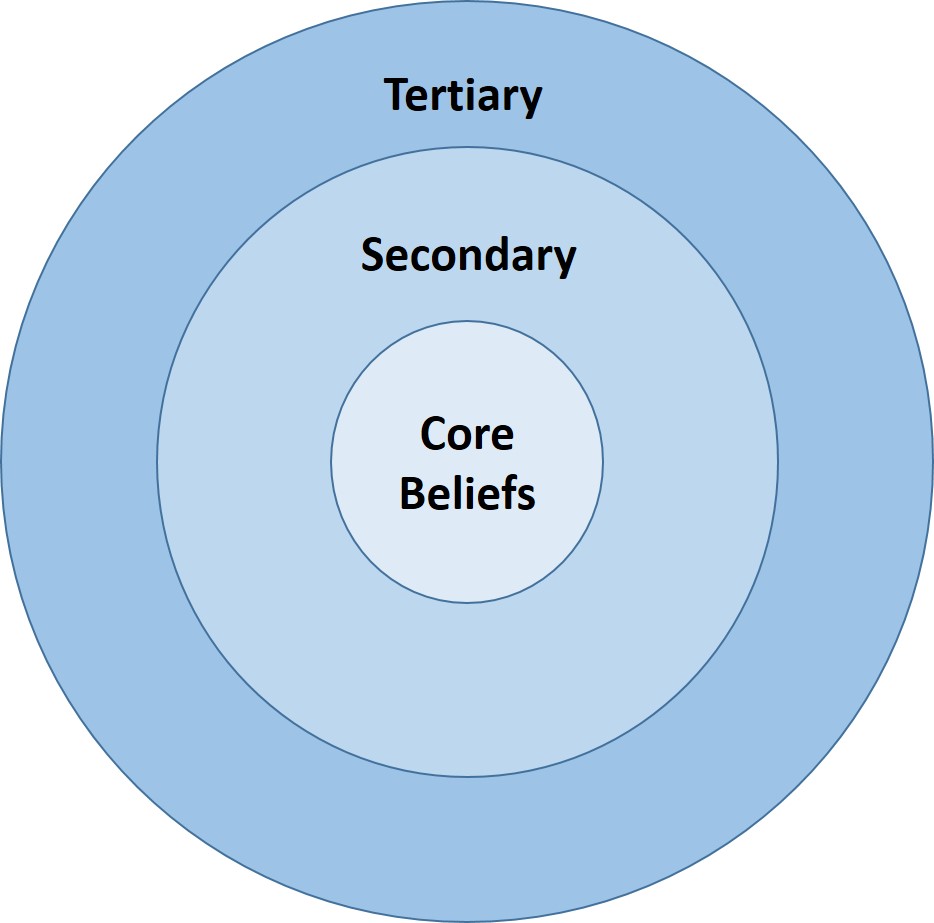
As an alternative to the house of cards, Boyd recommends a concentric circles model of beliefs. In a concentric circle, certain beliefs are more central or core than others. Outside the core are beliefs that are of secondary or tertiary importance. This does not mean that beliefs outside the core are not significant; it only means recognizing that not all beliefs are as vital as others. In this model beliefs are still connected to one another, but we ought to hold more tightly to those in the core, and less tightly to those further from the centre.
Is this idea itself biblical? I think so. For example, 1 Corinthians 15:1-3a sates,

Now, brothers and sisters, I want to remind you of the gospel I preached to you, which you received and on which you have taken your stand. 2 By this gospel you are saved, if you hold firmly to the word I preached to you. Otherwise, you have believed in vain. 3 For what I received I passed on to you as of first importance… (NIV)

The Apostle Paul goes on to describe “the gospel,” which serves as the ground of faith upon which Christians stand. Paul believed that some beliefs are foundational to the Christian faith, and this implies that others are not. Foundational beliefs are, then, those we can consider within the core of the concentric circle model. Not all beliefs can fit into the core, since not all serve as the ground of Christian faith.

Again, this doesn’t mean that other beliefs are not important, but not all are essential or primary in this way. It does mean, however, that we need to consciously commit ourselves to the idea that some convictions are second- or third-level convictions (or beyond). While valuable, non-core beliefs deserve to be held less tightly than others, and we need to be more cautious about allowing these to serve as criteria for Christian fellowship. A partial exception to this might be when it comes to denominational or church membership, but when it comes to accepting someone as a fellow Christian, the core beliefs are what ought to provide the criteria, and not those outside the core.

How the Concentric Circles Model Affects Us

Practically, what’s the benefit of the concentric circles model?

Personally, it helps us be less anxious when we feel less than certain about one of our beliefs, especially the non-core ones. We can incorporate questions and doubts into the overall process of maturing in our life of faith. We’ll be able to experience correction and modification of our beliefs, and ideally be open to pursuing truth wherever it might be found in God’s creation.

Socially, this model makes it easier to make room for others with different opinions. They will no longer be viewed as spiritually inferior or as a threat to the faith fortress. Instead, there will be an appreciation of diversity within Christ’s body in both beliefs and practices. And this should overall contribute to a healthier, stronger missional environment, since we will be less concerned with defending the fort, and more concerned with outreach.

The Spider’s Web: Supplementing the Concentric Circles

Now, it’s one thing to rationally adopt the concentric circles beliefs model, but quite another to live it.

Photo by Pixabay on Pexels.com

John Stackhouse supplements our discussion here by likening the way we hold our beliefs to a spider’s web (I think it was here that I heard him mention this). Any touch on one strand of the spider’s web reverberates through all the others, signalling the spider that it may be lunchtime or that an enemy is near. For us (non-spiders), when a question, doubt, or unfamiliar idea begins to tug at a strand even at the peripherals of our belief web, it vibrates to the core of our psychological and spiritual being. Even if we have rationally determined that a particular doctrinal belief we hold is non-core (say, whether biological evolution is involved in God’s creation process or not), when a challenge to that belief is presented, it may very well feel like our core beliefs are being compromised.

The spider’s web analogy should encourage patience with ourselves and others as we move from a house of cards model to a concentric circle model. We may rationally decide the latter model is the better option, but it will take our brains a while to catch up emotionally. It will be a slow learning process, so be ok with that. I think God is patient with us in the process too.

What’s in the Core?

All of this, of course, raises the question of what exactly should fit into the core of our Christian beliefs. And this is probably another area where Christians will disagree! But I don’t think we are left without wisdom in this regard.

What’s in the core?

Boyd proposes that any belief that is not directly necessary for linking one into relationship with Jesus should be considered peripheral to the core. This is good and helpful, but I’d like to propose another way of identifying what’s core. For me, what belongs to the core of Christian beliefs are those without which there would be no faith to talk about.

What would those beliefs be? I think that those outlined in 1 Cor. 15 are a good start (you can find this chapter here). There Paul states that the gospel, on which believers take their stand, is the story of God’s work in and through Jesus, through whom all things will be made right. This includes, then, the following beliefs:

  • The triune God exists and is working salvifically in the world he created
  • The Bible occupies a privileged role through which God reveals his salvation plan through Jesus
  • Jesus is the incarnate God-man who lived, was crucified and resurrected
  • Jesus ascended and poured out the Spirit at Pentecost shaping church life
  • Jesus will return and reconcile all things to the Father forever

A similar content is found in the Apostles’ Creed. That’s what’s core to the Christian faith, since without it, there is no Christian faith to talk about. This is not a story primarily about me or us, but the story of Father, Son, and Spirit, who wants to include us in the divine story.
What would fall outside the core? A whole lot. In my view this would include matters such as how God created the universe and humans and when, whether Jesus returns in two stages or one, whether God meticulously governs the universe or allows a measure of libertarian freedom to humans and other spiritual agents, whether tithing is necessary or just a helpful spiritual practice, and so forth. Such would not be core to Christian faith, but again this does not mean that these are not important—I tend to think some of these issues are very significant for how we live out Christian life. So some of the above would be closer to the core for me, but not in the core. This also doesn’t mean that opinions on these issues are all of equal value. Some may have more biblical and theological support, and so be truer than others. It’s just that they are not core to Christian faith.

Finally, it also needs to be acknowledged that whether a non-core doctrine is still retained as a denominational credential or church membership requirement is a different matter. Denominations need to be practically allowed space to define who will be allowed in their leadership or membership, and so even secondary and tertiary beliefs may be identified as “essential,” not for being a Christian, but for holding association within a formal institution. My only caution in this regard is that denominations should probably add as few non-core doctrines as possible to their membership essentials (just like the church did in Acts 15). This will help the denomination avoid ghettoizing itself, and open it to the potential creativity and ideas of those who may have different views, backgrounds, and experiences than those traditionally embedded in the formal organization. As a Pentecostal, I happen to think that Acts 2 and 15 encourages holding less tightly to non-core matters of doctrine and community ethics for the sake of mission, and including all sorts of others so we can better bear witness to Jesus. But that’s all I’ll say about that here.

My hope for this four-part series has been that it would provide a way of navigating through doctrinal uncertainty and change. If it has helped you or if you have further questions or thoughts, please let me know by commenting below (or by sending an email). Thanks for reading!

Reflection

  • Have you been holding your beliefs in more of a house of cards or concentric circles model? How has this psychologically affected the way you’ve lived out your faith?
  • What theological truths would you place in the core, and which ones would you place outside of the core? Why? What non-core beliefs are closer to the centre for you, and why? How do you determine what belongs in the core?

Peter Neumann is available to speak at your church or other gathering about this and other theological and topics, including: emerging adults and faith, salvation, the Holy Spirit and Pentecostalism, and other questions about the Christian faith. Peter can be contacted at peter.neumann@mcs.edu.


Navigating through Doctrinal Change: A Guide for the Perplexed, Pt. 1

An Exciting and Awkward Time

This is an exciting time to be teaching theology, but it can be a bit awkward when teaching doctrine. Let me explain.

I’ve been teaching theology for about 17 years at a Pentecostal denominational Bible College (Master’s College and Seminary [MCS]). I’m noticing a significant difference in the theological ideas and debates that our current students are exposed to compared with what I faced during my time as a Bible College student in the late 80s and early 90s.

pexels-photo-590493.jpeg

Back then we didn’t spend a lot of time exploring theological perspectives that differed much from denominational doctrine. Alternative views were not immediately relevant to the average churchgoer, and so there was less need to train students in how to understand, assess, and even possibly utilize elements from differing theological perspectives. And if we really wanted to explore divergent views, we would need to access an actual library with actual hardcopy theological books and journals.

Skip ahead twenty-five years. The situation has changed radically.

Change in Information Access

During the past two+ decades theological debates within evangelicalism and Pentecostalism have risen sharply.

pexels-photo-607812.jpeg

Alternative perspectives in areas that were once considered closed matters, were suddenly being discussed as viable options (think atonement theories [penal substitution was the winner] or biological evolution [not the winner] or biblical hermeneutics [author intent is THE only correct way to interpret the Bible]). And to make matters more interesting, these ideas were now being disseminated not in dusty libraries but over the internet, from a cacophony of voices, and through a variety of media. Want to be updated on the latest theological idea? No need for a hardcopy book, or even to know how to read.

One radical difference between students now and students twenty-five years ago (in basically any educational institution) is that contemporary students no longer rely on teachers to be conduits (or censors) of information. Information is everywhere, in multiple formats, and incredibly easy to access. Just ask Google.

Marching-off-the-map

Tim Elmore, educational expert on Millennials and Gen Z, states,

“May I remind you—today’s young people are the first generation that don’t need adults to get information. It’s coming at them twenty-four hours a day. What they need from us is interpretation. Their knowledge has no context. Adults must help them make sense of all that they know; to help them interpret experiences, relationships, work and faith via a wise, balanced lens…. Teach them how to think.” (Marching Off the Map 53).

Needing Guides for the Theological Maze

The issue, then, is not access to information. The issue is what to do with information, including theological information. Students, and churchgoers today need teachers and pastors who are able to understand and practically evaluate (pros and cons) all sorts of theological matters.

This is indeed a fun time to be teaching theology. Options abound for discussion and debate, and teachers get to help students navigate the alternatives, and hopefully chart a course toward what is truest, wisest, and most biblical. Helping students traverse this perplexing theological landscape is not optional. Remember, they are already exposed to

pexels-photo-408503.jpeg

ideas and positions that might support, challenge, or even contradict what is being taught by their pastor or denomination. Social media makes this a daily reality. So, we do not have the luxury of avoiding current theological and societal discussions if we want to pass on our beliefs to subsequent generations. The good news is that the theology teachers I know (at MCS and elsewhere) love to help students navigate these complex issues. Teaching theology these days is exciting.

But as mentioned at the outset, teaching doctrine can be a little more awkward at times.

Doctrine vs. Theology

By “doctrine” here I am referring narrowly to denominational statements of faith (as opposed to more universally held creeds). I take “theology” to be the ongoing exploration of understanding God and what he desires of human beings. Doctrine, however, is a set of articulated beliefs intended to serve and define a particular Christian community. Theology continues to develop and grow in the knowledge of God; doctrine attempts to identify the confession of a group of believers in a given time and place.

bible_read_me

At MCS our mandate is to train students for leadership within a denomination (in this case the Pentecostal Assemblies of Canada [PAOC]). This means ensuring that students understand the particular and distinctive beliefs that the denomination holds, and as much as possible help them see why these beliefs are supportable biblically and theologically. But with the multiplicity of theological options that are publicly available today, it should come as no surprise that from time to time denominational doctrine will be challenged by new theological thinking. And this is when, for teachers, and pastors, things sometimes get a little awkward.

What happens when…

What happens when a fixed doctrinal articulation simply becomes difficult to understand in the present culture? Even if a denomination determines that it fully endorses its long-held faith statement, words and expressions change their meaning over time. This means that not changing the wording in doctrinal statement can actually result in the loss of its comprehensibility and value for subsequent generations.

pexels-photo-356079.jpeg

Further, what happens when certain doctrines appear to have less support biblically or theologically than was previously thought? After all, it is not as if human knowledge—including theological knowledge—has not increased over the past decades. Of course, new information does not immediately mean that old doctrines are wrong. But it might (yikes!). And if the latter, how is a denomination supposed to integrate possible updates on truth into old doctrinal systems in a way that does not appear to be unfaithful to God and disloyal to previous generations?

My Motivation – PAOC SOFET Refresh

What motivated this blog is that currently my denomination, the PAOC, is in the midst of a refresh of its doctrines, its Statement of Fundamental and Essential Truths (SOFET). I believe this is a healthy and necessary step. But this process makes it a strange time for denominational theology teachers (and pastors). My students also know that the PAOC is rewriting its doctrines. And they ask questions about what they are supposed to subscribe to—what the PAOC affirms today, or what it will affirm in a few years from now? (I always say “today” :-)).

Pastors have also approached me with similar questions. What are we supposed to teach about “doctrine X” at this time, when we know we are in doctrinal transition? It’s one thing to help students and congregants navigate the various theological beliefs that are out there. It’s an added challenge to help them understand how and why a denomination might find itself in a place where it needs to refresh its faith statement.

So, this initial blog was simply intended to set the context for my next one. Information, theological and otherwise, is everywhere. Students, teachers, pastors, and congregation members need to know how to interpret this information—what to hold tightly, what to let go, what to consider more deeply—and we all need help to do it. And in my case, this needs to be done during a time when my denomination, with wise trepidation, is slowly and carefully walking through a doctrinal refresh.

Are there ways of thinking that will help us navigate this process? I believe so. In part 2 of this topic I want to provide some tips for navigating the landscape of doctrinal change.

Reflectionpexels-photo-767197.jpeg

In the meantime, some questions for refection or response.

How have you been affected by the explosion of theological options in the past number of years (through social media and traditional books)? Overwhelmed? Excited? Confused? Other?

What are some ways of thinking that help you navigate through the many options? Has any particular person been a help to you? How?

Weary of Singing about Ourselves: Recovering the Neglected Dimension of Worship, Part 3

I’ve been arguing that we sing too much about ourselves in worship and not enough about God. Worship, instead, needs to be viewed as formational and as such should be more thoughtful and in general be structured around the story of God.

But a possible objection here might be that this approach sounds overly cerebral or maybe even too pragmatic. Isn’t an approach that makes worship serve the goal of Christian formation (discipleship) simply making worship a means to an end? And how would this possibly fit into a Pentecostal approach to worship?

Well, what is a Pentecostal approach to worship? Pentecostals have always had a subjective, experiential leaning in their spirituality and worship. From early on (although not so much lately) Pentecostals emphasized personal testimonies as a means by which to pass on their faith. Do we need to give up this rather subjective component of worship? I don’t think so.

Jean-Jacques Suurmond in Word and Spirit at Play, argued that Pentecostals (and charismatics) approach worship as “play.” Church mosaic detailsWorship is not a means to an end, but an encounter with God. But as “play” (or a game) it is built around both rules and structure (Word) and spontaneity (Spirit). Pentecostals have emphasized the spontaneous aspect of worship, but their worship has never really been “unstructured.” (See Daniel Albrecht’s Rites in the Spirit on this.) For Pentecostal worship to work, it always had to have had a basic framework in which the spontaneous elements were able to be exercised. I’m suggesting that singing about God can help provide the structure in which the subjective aspects of worship (and song) can then be celebrated.

So, I am calling Pentecostals to be more intentional about making worship be more God-centred so that we can be formed into better disciples. I’m not calling for a removal of the holistic, physical, celebratory approach that characterizes Pentecostal worship. And certainly worship must be viewed as being an encounter with God. But for worship to be encounter with God it must be about God.

Let’s put it this way. The call here is not to move from non-formational worship to formational worship. All worship is already formational. The songs we sing, the prayers we pray, spontaneous or not, already are forming us in some way. Worship cannot help but be formational to some extent. And so, the call here is simply to recognize it as such. Once we acknowledge this, we will hopefully take more care to make sure it is helping to form us to be what we think it is that Jesus wants us to be/come. And I don’t think this can happen with the current glut of subjective-focussed songs.

One more implication. If what I’m saying is right, I think this will have some practical repercussions not only for what we sing, but also concerning who we place in charge of leading our congregations in worship and singing. If worship is about encounter with God that forms us into the people God desires us to be, and this is to be shaped by a focus on God’s story, then those who lead us must be people familiar with God’s story in a deep and profound way. Further, those who lead worship must know how to lead people into worship that has God as the subject matter.

Worship is such an important component in Christian formation that musical giftings just might not be the first quality that is needed in a worship leader. Worship leaders first of all need to have a good grasp on Scripture and the Christian tradition. Musical abilities are important, to be sure. But the task of leading people into God-centred worship entails not primarily musical skills, but theological and pastoral skills. So, all worship leaders must continually be growing in their knowledge of the story of God and how to translate this into meaningful words and actions for the people of God with the dual goals of encounter with God and Christian formation always in view.

Let’s move toward making God, not ourselves, the centre—the subject matter—of our worship.

Weary of Singing about Ourselves: Recovering the Neglected Dimension of Worship, Part 2

Admittedly, more than a little time has passed since my last blog.

But let’s think of this blog hiatus not so much as a matter of my being negligent, but more so of a long dramatic pause, in which anticipation has been building. Sort of like the year-long interlude between installments of The Hobbit or Hunger Game movies. 20131213_090610

This interruption raises some issues of continuity, of course, particularly because this instalment is a second part of a previous blog on worship. So it might be worth re-reading the first part. But without further ado, let’s get to it.

My contention to this point is that in Pentecostal (and broader popular evangelical) worship the subjective dimensions have been emphasized to the detriment of the objective. I’ve demonstrated what I mean by the “subjective” in my previous blog, namely having ourselves (humans) as the subject matter of our songs and prayers. Now I need to explain what I mean by “objective” and why it’s so crucial. Both aspects are necessary for properly formational worship, of course, but I think the objective dimension deserves priority.

By the objective dimension I am referring to God’s story being the focus, the subject matter, of our songs. This is the story we find in the Bible, and the story into which we find ourselves invited.

Subjectively-oriented worship songs highlight our personal relationship with God, through Christ by the Spirit, as an element of being included in God’s story. But this subjective dimension needs to be framed by God’s story lest we get the impression that all that matters is my personal relationship with God (and, more narrowly, the state of my internal psychological dispositions in that relationship). God’s story, the objective dimension of worship, is what gives meaning to the subjective dimension.

A focus on the objective dimension of worship means giving ample attention to God and his story. God’s story is found in Scripture. The Bible tells his story—his desires for humanity and creation, his plan, through Jesus, to redeem what has been broken and lost. The Bible does not simply make abstract statements about God (e.g., God is love), but places these in the context of a story that demonstrates the actions of God as, say, loving. What this means is that we don’t really know God unless we know his story. His story reveals his identity. Abstract concepts do not.

This implies that it is necessary but not sufficient simply to have the name “God,” “Father,” “Jesus,” or “Holy Spirit” in our songs. The subject matter of what we sing must not simply make offhand reference the proper names of God, but must actually revolve around God and his story. So, we need to ask ourselves about the subject matter of our songs. Is the song primarily about us or about God and his story? If the songs we sing in worship do not actually reiterate the story of God, then those singing will simply provide the content (from our imaginations) of what these names, or other abstract concepts, mean.

(So, it might not be a bad exercise to do a longer-term review of the songs regularly sung in our churches. In the past three months what has been the primary subject matter of our songs? God and his story, or us?)

The above may seem to be a fairly abstract way of talking about worship. But here’s what it practically implies for what we do when we gather together. In large part corporate worship is to be a reiteration or re-telling of the story of this God and his actions in history, with special attention given to the story of Jesus, through whom God’s redemptive plan is worked out. It is this that actually shapes the people of God to be what God wants them to be.

Assumed in what I’m saying here is a philosophical commitment that needs to be made explicit: I believe that worship needs to serve the ultimate purposes of discipleship and Christian formation. Worship ultimately serves discipleship. So, if worship is deficient, so too will be the discipleship of those regularly participating in that worship.

0924101413-00Here I’m not saying anything new. The church has always said that the “rule of prayer is the rule of faith.” In other words, the way we worship is what we believe; or, the way we worship shapes what we believe and who we are. But this means our worship needs to be theologically thoughtful and practically intentional—far more so than it often is.  A couple good resources on this are the late Robert Webber’s, Ancient-Future Worship, and from a more pentecostal angle (note the small “p”), Glenn Packiam’s Re-Forming Worship.

Worship, then, is to serve to regularly retell and even re-enact the story of God, so that we are again and again (and again) reminded of the God with whom we have to do. Only in this way will our individual lives as followers of Jesus be properly given context. We will be drawn into a story that is much bigger than our own lives, and a story that in fact gives our lives meaning. In short, worship will help form us into the people—corporately and individually—that God intends us to be.

And this can only happen if the primary subject matter of our worship is God.

This view might well raise some objections and questions—particularly from Pentecostals, who might object that this view sounds too cerebral. I promise that’s not what I’m suggesting. But we will need to wait to address such concerns until the next installment, which I promise (pinky-swear) will not be long in coming.

Weary of Singing about Ourselves: Recovering the Neglected Dimension of Worship, Part 1

iStock_000003277185XSmallI believe in worship. It is crucial to the Christian faith, and for the formation of both congregation and individual believer. What Christians do in worship tends to shape attitudes, beliefs and behaviour, perhaps even more so that listening to teaching or a sermon. So, worship is important. It’s so important that we should ask, from time to time, whether our worship is forming us into what God would want us to be(come). I’ve been asking myself that question. Here’s what I’ve concluded.

I believe a great deal of worship today is overly focused on us, and because of this it contributes to deficiencies in Christian formation.

Let me explain.

First, what do I mean by “worship”? I’m aware that in recent years there’s rightly been emphasis on “worship” being what Christians do (are supposed to do) in all of life. This is intended to deliver us from the notion that attention on God is something that only happens during church services, whereas in reality our whole life matters to God. I get it, and believe it. But here I’m addressing “worship” in its more narrow sense—the times Christians gather corporately to proclaim the worthiness of God through song, prayer, Scripture reading, and so forth. Even more narrowly, I have singing in view, since that has always been one of the favoured worship expressions in the church, especially within Pentecostalism.

Second, to narrow things still further, I’m primarily speaking to Pentecostals here. That is the tradition to which I belong, and overwhelmingly my church-going experience has been in Pentecostal churches. It’s familiar turf for me, and so I’m more confident in speaking to this subtradition. At the same time, evangelicals can probably be included here, since Pentecostalism has increasingly influenced the broader evangelical spectrum. (See here.) So, my thoughts likely apply to a wider Christian audience.

But enough of these preliminaries.

My belief, again, is this: our worship (singing) is, at times, excessively focussed on the ones doing the singing. Put another way, I mean that at all too frequently the subject matter of our songs proclaims our human story(ies), while too often neglecting the story of the one for whom we have gathered to worship, namely, God.

The songs I have in mind here are ones that emphasize our experience with God (usually personal, less often corporate—another issue I’ll take up another time). The lyrics frequently highlight our internal psychological state (i.e., how I feel about God, or my relationship with God, or even how I feel about how I’m feeling). With rare exception such songs are generally celebratory (not lamentations—how did those ever get into the Bible?!), emphasizing everything from personal life transformation to intimate ecstatic or even romantic moments with God. In short, these songs are often highly personal, internal, and emotion-focused. The content is primarily a reflection on one’s personal journey, and/or internal psychological states with regard to relationship with God. The subject matter of these songs is about us.

Now, human stories do provide an important element in worship—let’s call this the subjective dimension of worship. When we sing about our life of faith, our feelings about God and so forth, these are important expressions. Pentecostals have reminded the church globally that it’s right to celebrate God, and even testify concerning our experiences with God.

Pentecostals have always believed that spirituality involves more than the mind—the body and emotions also matter. And so worship involves not only mind, but also how we feel, and our physical gestures (hands raised, shouts, dance, tears, etc.). It is this physicality that has bled over into evangelicalism. Observe worship in many evangelical churches and services today, and you’ll notice people raising hands, moving their bodies, and proclaiming praises aloud. Such things are evidence of the Pentecostalization of evangelicalism.

Pentecostalism, in the early days at least, also prided itself on telling and hearing personal testimonies of how God was working in the lives of believers—bringing healing, conversions of a prodigal loved one, and fresh baptisms of the Spirit. In doing God became not simply a point of doctrine for many believers, but a living reality. God was one who was involved in all of human life, interrupting the course of things to transform and touch hearts, or to bring inspiration and healing. So, it only made sense to testify, robustly, about such experiences in word and song.

And all this is good—so far as it goes.

But testimonies, in word or song, especially once they become focussed on internal psychological dispositions, can lose their location in the broader and more important story for Christian formation: God’s story. Let’s call God’s story the objective dimension of our faith and worship. It is this dimension that I fear is largely being neglected to our long-term spiritual detriment.

I’m not sure of all the reasons, but we sometimes tend to believe that the best worship is that which expresses our personal feelings. Again, I’m not against expressing emotions in worship. After all, why wouldn’t we? And of course God wants us to be sincere in worship. But let’s not confuse heartfelt sincerity with worship that is in “spirit and truth,” as Jesus says (Jn. 4:24).

Let’s face it, sometimes worship songs can even become downright sappy. In my more cynical moments I’ve wondered if certain songs have been composed by a group of 16-year-old girls who have just watched the entire Twilight movie series in one sitting, replacing the name of some dreamy vampire with “Jesus” (if Jesus’ name appears at all—usually it’s just a pronoun: “he” or “you”).

Okay, enough cynicism. But let me provide one ironic illustration of how, even with our best intentions to focus on God, we still end up singing about ourselves: Matt Redmond’s 1999 song, “Heart of Worship.”

Yes, I’m aware of the background story to the composition of the song (see here: http://www.crosswalk.com/church/worship/song-story-matt-redmans-the-heart-of-worship-1253122.html). My point is not to dismiss the song. I think it’s a beautiful and meaningful song, and a testimonial of what God did in one situation, and quite likely needs to do in all our lives from time to time.

My point is that the song is ironic. A friend pointed this out to me a few years ago. Look at some of the lyrics.

When the music fades
And all is stripped away
And I simply come
Longing just to bring
Something that’s of worth
That will bless your heart

 I’ll bring You more than a song
For a song in itself
Is not what You have required
You search much deeper within
Through the ways things appear
You’re looking into my heart

I’m coming back to the heart of worship
And it’s all about You
All about You, Jesus
I’m sorry Lord for the thing I’ve made it
When it’s all about You
It’s all about You Jesus

The “heart of worship” is Jesus, according to the song. But the song is not about Jesus. The song is about a personal existential journey, away from being mesmerized by human performance to attention on the one for whom the music is being played. It’s a story about Matt Redmond, and based on how well the song caught on, a song about many, many of us. But the subject matter of the song is, overwhelmingly, not about Jesus, the heart of worship.

We are, I think, so used to the subjective dimension of worship—singing and hearing songs about our experience of God—that we simply might not realize we are sometimes neglectful of the objective dimension of worship. We are missing singing and hearing about God’s story. And it is detrimental to our spiritual formation, and the Christian faith.

That’s all for now (this is far too long as it is). I’ll say more about why I think this objective dimension is important in part 2 of this topic.

Is your (view of the) church too small? Pt. 2

By way of reminder, last week I began a review and reflection on John Armstrong’s book, Your Church Is Too Small. In it he argues that our view of the church needs to expand beyond our own local congregation. Really, he is emphasizing that the evangelical world has lost the idea that the church is “catholic”—again, not Roman Catholic, but a visible (not merely invisible) global community of God’s people.

Closely associated with this view of catholicity is church unity or oneness, a sense of belonging to the broader church made tangible in what we do in local congregations. A deep appreciation for the catholicity and unity of the church is needed in order to fulfil God’s mission in the world, says Armstrong. And he argues his case biblically and theologically, as well as practically.

Biblically, Armstrong points to John’s Gospel, for example, and highlights Jesus’ prayer for unity (John 17). Why would Jesus have bothered to pray for unity, asks Armstrong, unless this would be a real challenge for the church? Practically, it’s far easier to simply ignore the broader church and other congregations, and build one’s own local kingdom, isn’t it?

But Jesus’ prayer for unity means that Jesus believes that the church unified was and is the best witness to the reality of God. It also means that Jesus knew this unity would not be easy. And so he prayed for the church, specifically for its oneness.

One of Armstrong’s most troubling observations (to me at least) is this: The evangelical church typically operates with the assumption that a divided church is normal, if not normative, and good. Armstrong writes,

“Many Christians, especially evangelical Christians, have accepted the idea that a deeply divided church is normative. Some even believe mission is best advanced through this divided church. To challenge this mind-set is not easy, but I believe it is time for Christians to reconsider the ecumenical implications of believing that there is ‘one holy catholic and apostolic church’.” (ch. 19)

How did it come to this? Where we think disunity is normal, and perhaps more effective for doing God’s mission? Is there not a profound misalignment here with Jesus’ prayer for unity?

To be clear, Armstrong is not asking for a unity that supresses diversity, nor one that ignores doctrinal differences between denominations. He is not advocating an embrace of Roman Catholicism or Eastern Orthodoxy (although he believes both of these traditions have much to offer and need to be listened to carefully). He is, however, asking Christian leaders to seriously consider that church unity and catholicity is part and parcel of the mission of the church, local and global.

So, lots to think about here. I thought this topic would be a two-parter, but I think I’ll stop here (which means a part 3 is in the works).

To recap, Armstrong is advocating that the present acceptance of church disunity is a tragedy, and that church unity and catholicity should be an integral part of kingdom mission. I think he would say that a local church that does not have church unity and catholicity woven into its mission is a church operating with a deficient view of what God has called the church to do. Without working toward tangible, visible unity and catholicity as part of its call, local churches will not properly bear witness to Christ.

I think Armstrong is really on to something here. How about you?

Is your (view of the) church too small? Pt. 1

A couple of days ago I finished John Armstrong’s, Your Church Is Too Small: Why Unity In Christ’s Mission Is Vital to the Future of the Church. It has given me lots to think about. Here’s the link to the hardcopy (I read mine on Kobo): http://www.amazon.ca/Your-Church-Too-Small-Christs/dp/031032114X/ref=sr_1_1?ie=UTF8&qid=1374853633&sr=8-1&keywords=your+church+is+too+small

IMG_5013  This is not a church growth book, in the popular sense.  The “too small” church does not refer to the size of any particular local congregation, but rather to the vision of the church typically assumed in evangelical contexts. In this view, the church is a local assembly, invisibly (read vapidly) connected to the church universal. This allows local congregations and pastors to think they can get on with the business of the church by building their local congregation while practically ignoring the rest of the church globally.

Armstrong believes that this view is a key theological/biblical problem and practical hindrance to the mission of the church today. He argues that a crucial component of the way forward for the church in a post-Christendom world is a rediscovery of the need for church unity and catholicity. Part and parcel of the church’s mission is tangible work toward demonstrating the universal visible reality of the church, and so Armstrong advocates what he terms a “missional-ecumenism.”

Armstrong readily admits that he once held the traditional evangelical (shal)low church view, along with its suspicion of ecumenical dialogue, for a long time. It was only through study of Scripture and church history that he claims led him to appreciate that a stronger catholic view of the church is what will ultimately enable the church to fulfil its mission. “Catholic” here does not refer to Roman Catholicism. It simply refers to the idea that the church is global and visible in a variety of cultural expressions, and yet at the same time is one by the Spirit—and that this needs to be visibly expressed. Part of the church’s mission, then, is to preserve its catholicity in order to be the best witness to the world. Ignoring this aspect of mission is actually counter-productive to being the people of God and bearing witness to Jesus—in other words, not sufficiently missional! Yikes!

I’ll pause here, and leave the rest of the review to a future date. But it’s a good place to ask whether our own view of the church looks like what Armstrong describes as typical among evangelicals (and Pentecostals too) especially in North America. In short, this is the view that says we belong invisibly the church universal, but what matters is my local congregation, period (more or less). Unity is of course important within the local congregation (to keep things functional, and the pastoral vision central). But working for any broader church unity is of little practical importance, and may even work against promoting our local church by giving attention elsewhere.

I was pleased, back in 2005 at an A2 Conference in Chicago, to hear Bill Hybels admit that this had basically been his view of the church until God began to change his mind. He stated (and I’m paraphrasing from memory here) that in his mind he had wished other congregations good luck (hope it goes well with you!), but in practice all that mattered was the Willow Creek congregation. I appreciate Hybels’ honesty, humility, and willingness to change his views—a lesson for us all. But it does confirm Armstrong’s suspicion that for many, if not most evangelicals, catholicity is by default off the radar when it comes to church mission and priorities.

So, what’s your view? Does catholicity factor into what your church prioritizes? Is it part of your personal view of the church? Should it be? If so, in what ways and to what extent? Have you ever considered that working to preserve catholicity is an integral part of the mission of the church, and by extension, your life mission?