

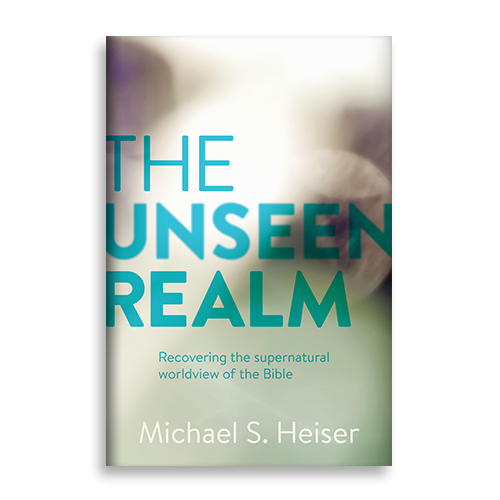
There’s more to reality than we can see, and this truth is important to understanding the gospel and Christian spirituality than might be supposed. That’s the premise of Michael Heiser’s, The Unseen Realm: Recovering the Supernatural Worldview of the Bible, in which he explores biblical glimpses into a spiritual reality that exists alongside and integrated with the physical.
The scriptural supposition of the existence of an invisible realm inhabited by spiritual beings is one that Heiser admits took him by surprise. It was his encounter with Psalm 82 that first caused him to rethink some of his own theological beliefs. The Psalm seemed to strongly suggest that God rules his creation with the help of a spiritual divine council—“gods”—although in that text it appears that God is not always pleased with members of this council.
God has taken his place in the divine council;
Psalm 82:2-3, 6-7 (NRSV)
in the midst of the gods he holds judgment:
“How long will you judge unjustly
and show partiality to the wicked?….”
I say, “You are gods,
children of the Most High, all of you;
nevertheless, you shall die like mortals,
and fall like any prince.”
Seeing the Bible with fresh eyes

This unfamiliar yet inescapable depiction led Heiser to dedicate himself to investigating what the biblical writers assumed about the nature of reality—both the seen and unseen—and the way God governs it. What he concludes is that coming to the Bible with the assumptions of a modernistic, Enlightenment worldview is simply not helpful for comprehending the full scope of created reality to which it points. The evidence concerning what the biblical writers believed is undeniable for Heiser. The biblical witness univocally affirms that there exists an unseen “supernatural” realm, inhabited by spiritual creatures who, like humans, exist for the purpose of imaging their Creator, and who participate in the way decisions of cosmic (and lesser) scope are rendered.

Whether contemporary Christians accept the reality of these biblical witnesses is a separate question; and Heiser acknowledges this acceptance might be difficult for some. As a Pentecostal, however, I didn’t find his presentation a challenge to my tradition’s beliefs. Pentecostals are quite comfortable with the idea that spiritual beings, both benevolent and malevolent, not only exist, but affect the world in ways large and small.
A cautious Pentecostal
I admit, though, that in practice I’ve been cautious (maybe even skeptical) about embracing stories of the involvement of spiritual entities in the physical realm. I don’t tend to be drawn to the Christian pop-supernatural media and literature that’s readily available. I also am reflexively repulsed by (what I consider to be) ostentatious displays of “spirituality” by some charismatic leaders in North America, and believe such to create needless barriers to the message of the gospel.

What I personally need to be careful about, however, is to distinguish questionable practices, too easily embraced by some Pentecostals and charismatics concerning spiritual reality, from the actual existence of this unseen reality, overwhelmingly affirmed by the biblical writers. Concerning the latter, Heiser’s book has been the most comprehensive and compelling discussions of this topic I’ve come across.
Rather than try to summarize Heiser’s work, here I’ll just highlight two claims I believe he convincingly argues, which have helped supplement my understanding of salvation history and approach to Christian spirituality. In doing so I hope this will intrigue others to pick up this book.
The Elohim: the council of the “gods”
Hebrew Scripture at times refers to “elohim,” which English translations may render as “gods” (such as in Psalm 82, NRSV). Heiser argues that the elohim are in fact spiritual beings that serve as members of God’s divine council. Humans were created in God’s image to be part of this council (alongside the elohim, who also image God), but are currently functioning at less-than-intended capacity in this role due to rebellion (Genesis 3).

God is also an elohim, but not merely one among others in the council. Rather, he is the supreme Elohim, Creator of all that is seen and unseen. God employs a divine council in his decision-making because, argues Heiser, he delights in including others in the planning and outworking of creation and history. Some elohim have remained faithful to God, while others have not. Disloyal elohim operate malevolently in creation, whereas elohim allegiant to God serve in any number of roles, including as messengers (angels).
Being aware of this “council” theme has caused me to reconsider the ways I have perhaps too easily ignored or quickly dismissed prayerful references, within my tradition, to spiritual forces at work in the world. I’m still not persuaded to embrace spiritual prayer practices that can at times seem more like incantations than relational entreaties (and too closely resembling how Jesus explicitly tells us not to pray in Matt 6:7). But I do find Heiser’s arguments persuasive for the existence and involvement of spiritual beings, both good and bad.
What might this mean for my own spiritual life and practices, in particular the way I pray and discern? Heiser has made me realize I need to give more thought and attention to this.
Elohim invasion and salvation history

Perhaps more fascinating is Heiser’s claim that the strange and oft-overlooked story of Genesis 6:1-4 is actually central to understanding salvation history.
When people began to multiply on the face of the ground, and daughters were born to them, the sons of God saw that they were fair; and they took wives for themselves of all that they chose. Then the Lord said, “My spirit shall not abide in mortals forever, for they are flesh; their days shall be one hundred twenty years.” The Nephilim were on the earth in those days—and also afterward—when the sons of God went in to the daughters of humans, who bore children to them. These were the heroes that were of old, warriors of renown.
Genesis 6:1-4 (NRSV)
According to Heiser, this terse tale recounts malevolent elohim (“sons of God”) illegitimately involving themselves in the physical generation of some sort of hybrid human offspring. The descendants of these offspring apparently serve as a more explicit and serious invasion of evil into the physical world than even the human fall in Genesis 3 (where a insurgent elohim is identified as the tempter). Much of the Old Testament recounts how this invasion is countered, and this theme is carried into the New Testament in and through the life of Jesus and his message of the kingdom of God, and finds its conclusion in the new creation. In other words, salvation history is largely, perhaps primarily, about overcoming an illegitimate spiritual invasion.

This portrait of God’s salvation intentions and activity is notably wider than simple provision of forgiveness for human rebellion. God’s aim is to overcome the spiritual invasion and corruption of the world by rebellious elohim, and the gospel, then, is an announcement that Jesus has come to re-establish God’s legitimate rule in the physical realm. The proper response, of course, is to give one’s loyalty to this one who is the supreme Elohim.
Again, this increases the scope of salvation history, and has implications for Christian spirituality and evangelism. Christians are those explicitly involved in a spiritual war, having pledged their allegiance to Jesus over against forces and powers that threaten God’s good intentions for this world through Jesus. They should expect their allegiance to be challenged spiritually. Further, the call to give allegiance to Jesus involves more than simply a prayer for forgiveness (although it includes this). The call to follow Jesus is a call to choose sides in a spiritual battle.
Recommended reading (and listening)

The above discussion simply identifies two points that have caused me to reflect on the implications for my own spiritual life and teaching in my theology courses. But there is much, much more that could be discussed concerning Heiser’s book. For example, he gives significant attention to exploring the scriptural origins of Trinitarian theology, including the appearance of God in physical form in the Old Testament a number of times. So, this is a book that will be of interest to Christian leaders and theologians alike. And if you are still wondering whether to give the time to reading The Unseen Realm, for the curious I recommend at least listening to Preston Sprinkle’s podcast interview with Heiser.
 Peter D. Neumann