

Last week I posted about the tenuous distinction between tithes and offerings based in the OT book of Malachi (based on David Croteau’s book). And I asked readers to respond to a couple of poll questions concerning the topic. The results are provided below, and they raise some questions for me. But first a recap.
Recap

In brief, Malachi 3 mentions that Israelites had been robbing God by their withholding of tithes and offerings. Contemporary Christians often identify tithes (10% if one’s income) as being the required amount one should give to one’s local church. Offerings, however, are often identified as a distinct voluntary gift that one can give, over and above the tithe. The tithe is obligatory, the offering is a freewill gift.
The problem is that Malachi knew of no such distinction. Both tithes and offerings, while technically distinct types of giving, were both obligatory. So, does this mean that the church today should require both tithes and offerings of its adherents? (And in that case, what amount or percentage is an acceptable offering?) Or should the church stop teaching that “tithes” = obligatory and “offerings” = voluntary, and just admit that Malachi isn’t teaching what we might have thought he was teaching regarding offerings, and just stick with requiring tithes and stop mentioning distinct “offerings.” Or should we keep requiring tithes and asking for gifts over and above tithes, but admit that calling such “offerings” is just a matter of convenience without direct biblical support. (After all, we can find encouragement to give generously elsewhere in the NT, although not with neat percentages attached). (See my last post for more details.)
How Do We Use Scripture?
My interest in all this actually has little to do with giving or tithes or offerings. I’m mainly curious about the way we support our theological beliefs and practices, and how Scripture serves in that process. Specifically, I’d like to get a clearer picture of the method used to apply Scripture and our consistency in doing so. After all, if Scripture is God’s word, it means that to claim “the Bible says” is equal to “God says,” and that can be not only a debate stopper, but also a powerful motivator for moving people toward particular beliefs and behaviours that I (or a group of people) deem fitting.

In short, we should be very aware how we use Scripture to ensure that we are not using it in ways that God himself might not stand behind. If we knowingly decide to use Scripture to bolster our claims, when in fact we suspect that the Bible might not quite be behind those claims, then we are, for all practical purposes, using God (rather than submitting to God) to support what we believe and want to be the case, and desire others to follow. This is, of course, a subtle way of playing God and misusing authority over others, and Jesus had some sharp words to say about that in his Sermon on the Mount.
I need to also say, this does not mean that if we mistakenly misapply Scripture that we are using God in this same way. We are not. And God is much more patient with misunderstanding and misapplication than he is with intentionally misusing his words to back our agendas, even when those agendas might be very well-intentioned.
All that to say, the matter of tithes and offerings just happens to be one good way of teasing out how we use Scripture. I have some other plans to continue to explore this using other topics, but let’s not wait any longer and get right to the results of the poll.
Poll Results
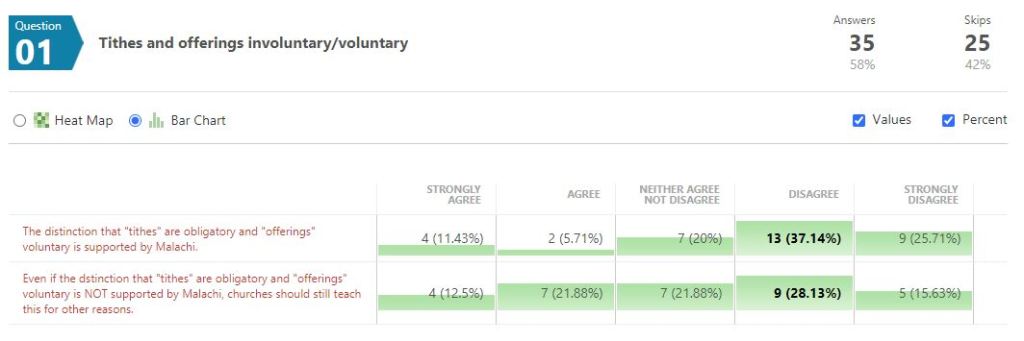
Sixty people began to respond to the poll — 57 from Canada, and three from other non-North American nations. But alas, only 35 actually completed the poll. Perhaps it was fear of their opinion on tithing being publicly discovered, which is not surprising in this day of rampant conspiracy theories. 🙂 But that fear was unfounded; the 2-question poll was anonymous.
Here is a graph of the poll results, and below that some commentary on the two questions.
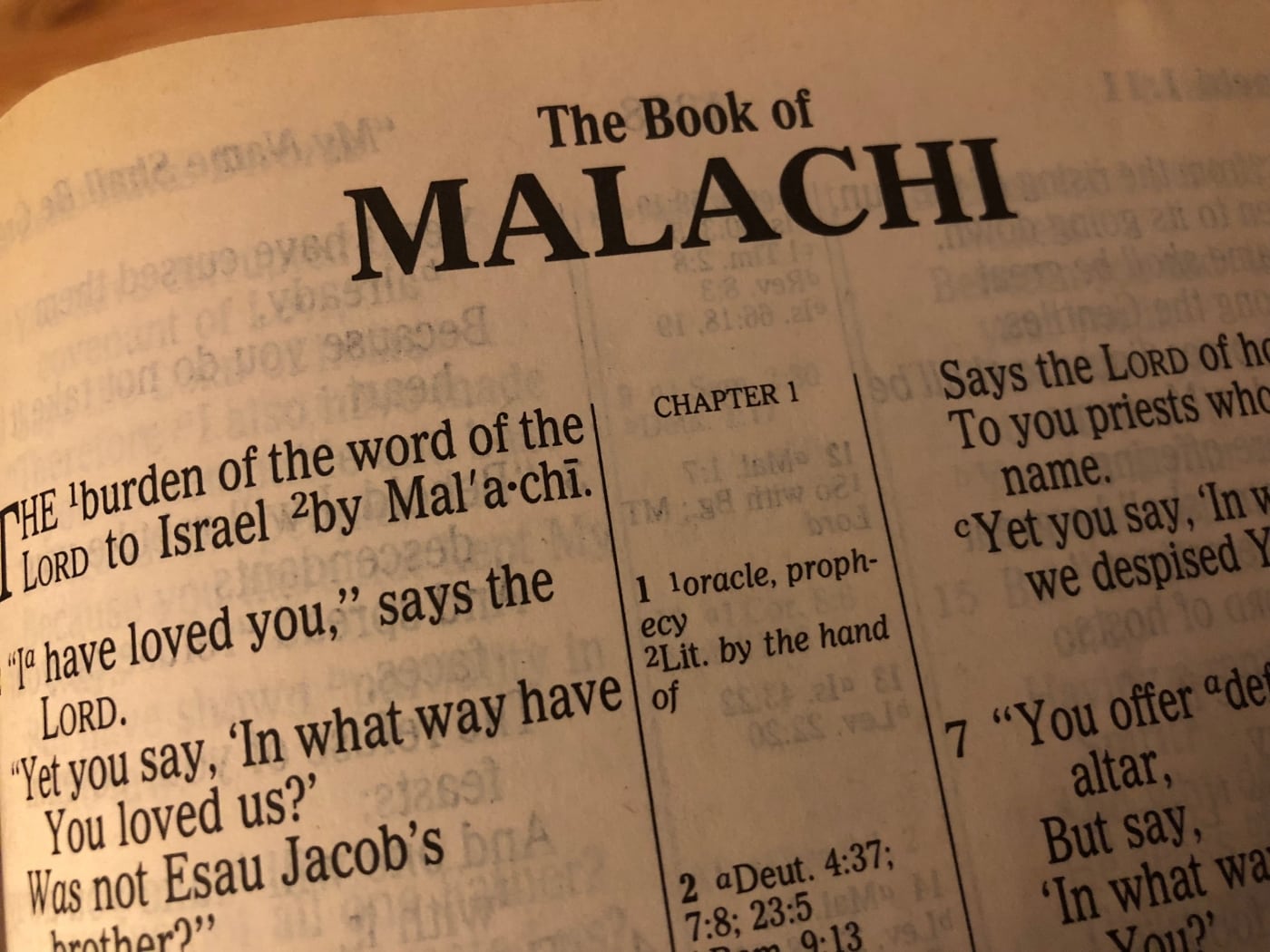
Question 1: The distinction that “tithes” are obligatory and “offerings” voluntary is supported by Malachi.

My question was very specific here. I was asking about Malachi only, and not the entirety of the Bible. Here the majority (almost 63%) find themselves in agreement with David Croteau’s interpretation of Malachi 3. I.e., Malachi is not teaching two types of giving, one voluntary and one obligatory. 20% are unsure about this, and about 17% appear to believe that Malachi does indeed teach a required/freewill distinction in giving (or they were unclear on the specificity of the question).
It’s the second question where things get more interesting.
Question 2: Even if the distinction that “tithes” are obligatory and “offerings” voluntary is NOT supported by Malachi, churches should still teach this for other reasons.
To be very clear, here’s what I was trying to ask.
Supposing Malachi DOES NOT teach the obligatory/voluntary distinction between tithes and offerings. In that case should churches still teach that there are in fact two categories of giving — one obligatory (we’ll call this “tithes”) and one voluntary (we’ll call this “offerings”).
Here the responses are not as unified, and it may be due to the question being misunderstood or due to other beliefs about how to use the Bible.
43% indicated that they did not agree with teaching the two categories of giving (at least not to use Malachi while doing so). And if they interpreted this question as I hoped, this also means they do not feel comfortable using the Bible to teach two categories of giving period. This does not mean (I assume) for these respondents that churches should not teach on freewill giving, but that the Bible doesn’t seem to provide sufficient reasons for breaking giving into the required/freewill distinction.
On the other hand, just over 34% believe that while Malachi does not teach the required/freewill distinction, the church should still teach this distinction for other reasons. I’m assuming here, again, that the respondents understood what we being asked. Here it would have been helpful to know what those other reasons might be, but this was just a teaser poll. About 22% were not quite sure what to think on the matter, and perhaps are still processing things. Fair enough.
Continuing to teach giving as compulsory and voluntary
Let me suggest a couple of possible reasons people might believe it is justified to continue to teach the compulsory/freewill giving category distinction, along with some thoughts on each.

- Respondents might believe we should continue to teach this distinction because of tradition and pragmatism. I.e., our church/denomination has said this distinction exists for some time now, and it has been a fairly helpful method of collecting resources for worthy ends, and people are used to it being taught in this way, so we should accept that it is a teaching and practice to be followed now.
I’m actually not opposed to tradition (carefully understood), and am not even against churches and denominations adopting teaching and practices not explicitly identified in Scripture, provided that Scripture continues to get to frame the way these are taught and practiced. Pragmatism also can be helpful, again, if mitigated by scriptural framing. But if tradition and pragmatism are to be given some measure of authority here, then I think it would be right to admit this to the congregation, and to admit that the Bible (and so God) doesn’t actually teach this explicitly. That way everyone knows that they are adapting to a lesser authority than Scripture itself, and yet it might still be a pretty good idea. After all, clear and simple directives are much easier to follow than ones that are more subjective and ambiguous. - The second reason for continuing to teach that there are two categories of giving (required/freewill) is perhaps the belief that there are other Bible texts that could be used to support this distinction.
Along with Croteau, we might want to ask, which ones? But thinking hypothetically, we could imagine appealing to the OT for tithing and the NT for freewill giving, and leave Malachi out of it with regard to offerings. In this case, the labeling of the distinct types of giving as “tithes” and “offerings” would still seem to be a matter of tradition and convenience. So, most transparently, I think it might be best to ditch the label “offerings” to refer to freewill giving, and simply call it something else like “freewill giving” so as to not confuse people when they read Malachi (since we want to take steps to not misuse the text).

That’s about it for this one. Thanks to all who participated in the poll. Comments are welcome!








 Peter D. Neumann