

Overcoming the Psychological Barrier of Speaking in Tongues

Ok, this title will probably over-promise and under-deliver. But I just wanted to post a link to a favourite epoisode of Greg Boyd’s Reknew podcast, where he outlines some of the psychological barriers we might encounter when trying to be open with experiences with God — in particular, speaking in tongues.
Now, understand that Greg is not a classical Pentecostal, and so will not interpret Acts the same as some denominational standards (e.g., the Pentecostal Assemblies of Canada). I actually think he over-simplifies when he rejects the classical Pentecostal way of reading Acts in the podcast linked below. But that’s not my focus here, and so let’s not let that get in the way of the great practical advice he gives when it comes to being “open” to unusual activities of the Spirit in our lives, including speaking on tongues.

“Open” is a metaphor that we often use in and outside church and spiritual contexts, but it is popular in spiritual lingo. By “open” here, then, I mean not allowing psychological barriers, whether of our own volition or not, to interrupt what God by the Holy Spirit might want to do in our lives.

Intellectual barriers that we might have are quite another matter, and will need to be addressed intentionally and fairly in other ways. I am not one to advocate for a “check your brain at the door” strategy for Christian faith and spirituality. This may have to do with my personality, but it also has to do with my anthropology (what I believe human beings are). In short, I think human beings are not merely brains on a stick (i.e., primarily rational creatures); nor do I believe we are merely a bundle of emotions and affections. We are both/and. So, any push to check our brains at the door is a push to ask humans to not be humans, something I don’t think that God wants of us.

At the same time, our brains can get in the way of simply being present and “in the moment” in all sorts of circumstances. We can, for example, enjoy a night out at a sporting event with our friends, or we can analyze what we and our friends are doing at the sporting event. This analyzing, rather than enjoying the moment, I’ll refer to here as our inner anthropologist.
Enjoying the moment, with friends or God, has not so much to do with rationality, as it has to do with knowing when to shut off the inner anthropologist. It is not irrational to enjoy time with others or with God. There is a time and place for anthropology with it’s “thick description” methods, but sometimes the inner-anthropologist needs to just join in the fun!
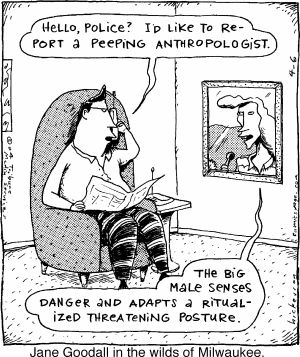
This, I think, is what Greg Boyd is getting at in his podcast liked below. Boyd is basically saying that we can psychologically block the working of the Holy Spirit within our lives by our inability to enjoy the moment, by letting the inner anthropologist unnecessarily work overtime when the work day is long over. If we learn to control our brains better (not check them at the door), we can actually focus on what we ought to be focused on in any given moment.
This includes moments of being open to the Spirit, and even to experiencing speaking in tongues, as mentioned in the book of Acts, chapter 2, and 1 Cor. 12 – 14.
Anyway, I played this in my Holy Spirit course this past week at Master’s College, and thought it would be worth passing it along to a broader audience. Click here for Boyd’s podcast.
Reflection: Has your inner anthropologist ever gotten in the way of you being in the moment, and experiencing the joys (or sorrows) of life, others, or God? What can we do to train our inner anthropologist to learn better manners and stop interrupting?

 Peter D. Neumann