

In the midst of an awkward but refreshing time of doctrinal reassessment in the PAOC, I thought it might be helpful to provide some tips for the journey. If you haven’t already, please read parts 1 (here) and 2 (here) first for context.
The first tip accented that challenges to our beliefs inevitably evoke some measure of anxiety. Recognizing this, a wise response is simply to accept and embrace this emotional reaction, and don’t panic. In short, don’t let anxious feelings determine our acceptance or rejection of new ideas.
Closely related is the second tip.
Tip 2: Be Open to Having Beliefs Revised (be epistemologically humble)
There’s a commonly-held assumption within conservative evangelical (and Pentecostal) church settings that leads to lot of anxiety (see my last blog). This is the idea that ALL the assertions being taught by the pastor (or itinerant evangelist, or Bible College prof) are absolutely true, since these assertions have been shown to have some sort of biblical basis. Since this teaching is connected to God’s view on the matter, any questions or doubts concerning the teachings of said preacher/teacher is equivalent to unbelief, or lack of faith in God. In short, what pastor said = God’s opinion, and therefore should not be questioned or doubted. This view may have been taught explicitly, or “caught” as part of the subcultural church atmosphere.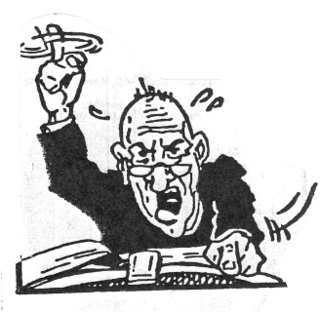
Comedian Mark Lowry aptly quips, concerning growing up under this type of atmosphere, “Our pastors were not always right, but they were never in doubt.”
But in case we’re tempted to think that this is an attitude of a by-gone era, I have reason to believe it’s not. I’ve had young adults confirm that this is the message they are currently receiving from denominational Christian camps, rallies, etc. Asking questions is not encouraged. What has been proclaimed from the person with the microphone is authoritative, on pretty much all things theological (and perhaps also on just about everything).
In its worst form this environment can lead to spiritual abuse (intentionally or unintentionally), but that’s a topic for another day. Here I will assume the best motivations of pastors/evangelists/teachers/leaders. The preacher wants people to be confident in their faith. And what better way than to simply assert what we believe the listeners need to believe as unchallengeable fact, and encourage them that there is now no further need to ask questions. It’s simple and easy. It avoids unnecessary nuance. But it doesn’t sufficiently appreciate how humans actually come to believe things and grow in convictions (i.e., it’s based on a poor anthropology and psychology).
So, I want to challenge the notion that because something has come to us from an authoritative voice, that this makes it absolutely true and unquestionable. Further, I want to challenge the idea that Christians should always (day in and day out) feel certain about what they believe, which is also something far too entrenched within the fundamentalist/conservative mindset. (If you don’t believe that this unfortunate attitude still exists, see this recent blog from Desiring God.)
What you’ve been taught may not be absolutely true!
Here’s the truth of the matter: what you’ve been taught (explicitly or implicitly) as absolutely true may or may not be. It’s ok to have honest doubts and questions about the Christian faith, and in fact asking questions and having doubts may be a means by which to grow in trust in and allegiance to Jesus. I realize there are online debates about this, with parties either advocating doubt as a sign of spiritual maturity or apostasy respectively (see here). But most of the time it is probably neither. It is likely simply part of the human process of learning about creation and about God. (On doubt as a potentially helpful tool towards growth in faith see 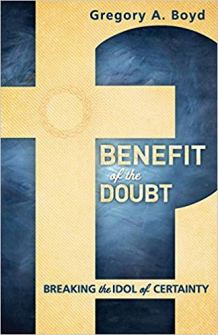 Gregory Boyd’s, Benefit of the Doubt, and Daniel Taylor’s, The Skeptical Believer: Telling Stories to Your Inner Atheist.)
It took me a long time to admit and accept this. The preachers I admired in my youth spoke loudly, confidently (angrily?), shook their fist in the air, and left no room to question their assertions. And I naively assumed I should (must) accept everything these well-intentioned leaders said as absolutely true. I also assumed that I also should adopt this same approach when I preached or taught (although I never could do this quite as well as they did). How could I doubt that these folks could be offering anything less than undoubtable truth, when they seemed so confident, so certain? I wanted my faith to look like theirs. Certain—absent of any doubts.
There are, however, two issues here that challenge the idea (what some call the idol) of certainty being a primary virtue in Christian life. Accepting these will help make us more open to learning and growing in our understanding of God and how he wants us to live in his world.
Humans can’t know it all
First, humans are limited in our ability to know things. This is part of what it means to be human. It is humbling. Humans do have much to be proud of; we are, after all, noble creatures made in God’s image, and have accomplished much. But we are not God. Only God has all knowledge (omniscience), and I’ll leave it to the Calvinists and Open Theists to argue about how to define that knowledge 😊.
Humans don’t have omniscience and never will. (As John Stackhouse points out, in Need to Know, God never even promises that we’ll understand it better in the by-and-by.) Humans can be wrong about our beliefs, and we all have been. Have you ever changed your mind about something that you firmly held with conviction when you were younger? Why wouldn’t it be possible to do that again as you learn more, even about matters of the Christian faith? Humans simply do not know everything, and this also applies to matters of Christian theology and doctrine. So, we need to be modest when it comes to what we know. Accept epistemological humility. We can be mistaken about what we believe about God.
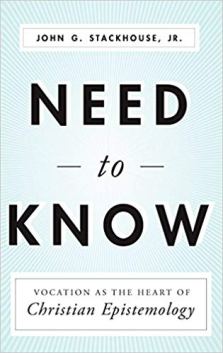 At the same time, while humans cannot know everything, we can learn and know lots of things. In fact God has called us to learn about himself and creation, and to continue to do so with the resources he’s provided (the Bible being the privileged resource in a dialogue that involves the voices of Christian tradition, arts, sciences, and experience). With God’s revelation and our cognitive abilities, he calls us to learning about himself, ourselves, and creation as part of what it means to bear his image. This means that theology is not a static deposit of propositions about God, but is a dynamic and growing endeavour. It may very well be the case that failure to learn and grow in knowledge—about God and the world—may even be a matter of disobedience to God’s call on humans beings to bear his image in this world (see Stackhouse). So, accept our cognitive limitations, and be open to continual learning—including correcting what we discover along the way to have been false beliefs.
But, this acknowledgement means we won’t always feel certain. And here we need to introduce another important distinction concerning certainty.
Being certain doesn’t mean you’re right
The second issue that challenges certainty as a virtue in Christian life is that certainty is a psychological disposition, not a quality that determines what we believe is true or not. Certainty is a state of mind in which we are firmly settled in our convictions and way of seeing things. As I’m using the term here, certainty refers to the belief that our convictions are so assured that we deem it unnecessary to be open to alternative possibilities being true.  But again, the feeling or attitude of certainty is not necessarily connected to whether our beliefs are true or not. I can feel absolutely certain about something, and be absolutely wrong. And in case you think I’m sounding too relativistic or “progressive” here (sometimes used as a default blanket term to dismiss anything not traditionally American evangelical), William Lane Craig argues the same thing in a recent podcast (here).
This is why it is simply a mistake, and a potentially damaging spiritually and psychologically, to encourage people to make this form of certainty a spiritual goal, as if it were equivalent to faith, and what God is expecting of Christians. It is not.
Because certainty it is a psychological state, it is pretty much impossible to maintain it at all times. Our levels of certainty about our beliefs will ebb and flow depending on mood and circumstances. At times Christians will feel unshakable confidence about particular doctrines of the Christian faith. Singing our favourite song about God’s love while in an inspiring celebration service may evoke deep assurance that we are indeed loved by God. But the next day, when faced with difficult challenges, our feeling of certainty is not quite as strong. Have we lost our faith? No. What we’re experiencing is the ebb and flow of our emotional state. What we should do is grow in our trust in God and accept that the diminishing feelings of certainty are not the foundation of our relationship to God. Demanding certainty as a virtue will ultimately lead to failure to live up to this ideal, and lead to discouragement, and possibly unnecessary guilt and shame.
Convictions and personalities
It is, of course, good to hold convictions. There is good reason for being convinced of the truth of the Christian faith. And Christians need to be people of courage and conviction (especially in a time in culture where it seems at times that everything is up for grabs). But conviction, as I’m using it here, does not entail the idea of having arrived at absolute certainty, and so means not closing oneself off to possible revision of one’s ideas based on new information or new perspective. Conviction grows based on trust and learning over time. Conviction is what preachers and teachers should encourage; but growing in conviction usually means having permission to ask questions and carry doubts for a time. It may even mean simply allowing oneself to say, “I’m not sure” about matter X, while feeling more sure about matter Y. So, conviction, yes; certainty, no.
I also suspect that certainty is often related to personality,  perhaps more so than it is to truth. Some people are simply very confident in their opinions; they feel and display certainty concerning—just about everything! Sometimes that is what preachers believe they must portray in public. But I think we need to be careful about making this a model, especially since it will immediately alienate those whose personalities don’t share this ubiquitous confidence.
In my experience, the portrayal of certainty as a model of virtue and faith has short-term benefit. People love an easy and simple answer to the complexities of life, and certainty is catchy—it will temporarily elevate others’ psychological disposition of confidence. But certainty as a virtue often produces long-term problems, including the above-mentioned discouragement, and even possibly loss of faith when it is discovered that the preacher was not correct about some matter on which certainty was claimed. Certainty doesn’t allow for people to ask questions, or to hold different opinions; and it does not allow even God to teach us new things about himself. Any new idea or perspective will be viewed as deviation from what is “absolutely true” and certain, and so as a threat.
Pentecostals and openness to new revelation
For those in the Pentecostal tradition, embracing certainty as described above runs contrary to what early Pentecostals believed. These folks assumed that the Spirit continued to speak and reveal new things about God (of course not in contradiction to Scripture). One could, ideally, speak with conviction by the Spirit, 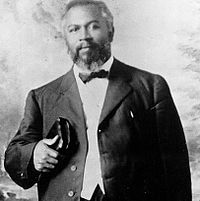 while being open to revision, should God choose to correct our understanding (through Scripture, a direct message from the Spirit, or even through study of science and history).
In contrast to this early Pentecostal disposition, demanding certainty tends to shut down even the possibility that the convictions we hold (or that a preacher wants us to hold) could be wrong or could require revision. Again, certainty is not a quality of the beliefs we hold (it does not tell us whether what we believe is true or not)—it is simply a mental disposition associated with what we believe. The reality is that certainty can just as easily make us closed to God’s truth as it can help us stand up for God’s truth. Certainty cannot be the sole criterion on which we evaluate our faith and spirituality.
Doctrinal drift or doctrinal correction?
I’ve meandered a bit here, but let me bring this back to apply to the PAOC’s SOFET refresh. In the midst of doctrinal revision, we need not assume certainty about held doctrines as a primary virtue to which we must hold. God is still in the business of helping his people learn new things—about creation, and even about God and the Bible. I say this because it is sometimes supposed that any deviance from what was previously accepted as “absolutely true” in a doctrinal statement must be a movement away from

God’s truth; it is viewed as “doctrinal drift.” But this is not necessarily the case, and assumes that doctrine is something that exists as a timeless and unchangeable body of knowledge. That’s not quite how doctrine works, and we need to be more patient about assuming “drift” before we’ve had time to examine the issues. Movement away from some held doctrines may be a move toward more, not less, truth as far as God is concerned. We may also need to recognize that some doctrines are more central to our faith than others, and hold the latter more lightly (I’ll discuss this more in part 4).
This maybe difficult to accept. After all, we were taught by pastors and teachers we loved and admired. And when they taught they often did so with a passion that conveyed (intended or not) that they were passing on absolute truth about all (or at least most) matters. So, if it was good enough for that Bible College prof decades ago, it should be good enough for all PAOC credential holders forever (I’ve really had someone say this to me)! But who is to say that our teachers of the past may not have changed their minds on issues? Would it surprise us if they did? And our teachers were also fallible people like us, who could simply be wrong about some things. Would it surprise us if they were?
Would it surprise us that the PAOC has changed its doctrinal statement a number of times in its history? And according to my friend Andrew Gabriel (see his site here), the only statement we’ve never revised is the one on tithing (we don’t want to even explore the possibility we might have got that one wrong 😊).
My point here is simply that we need to be less rigid and more humble about what we think we know, especially about theological matters. We need to be open to learn new things—about God, the universe and everything. After all, only God can claim omniscience.
Certainty not required
In sum, not every teaching we’ve received in church is “absolute truth.” It’s ok, and even intellectually necessary to have doubts and ask questions, and even to change our minds about things we once felt certain about. Let’s be humble and open to admitting that we don’t know it all and have much to learn.  This doesn’t mean we can’t hold convictions or stand up for truth. But we are not required to avoid uncertainty (nor are we able to).
As we grow in our faith, we’ll probably find that we become more convinced about some beliefs, and less certain of others. But the process is not easy or simple. Dallas Willard describes (see source here) what we must do (I’m paraphrasing here, but I think this is almost verbatim):
Believe your beliefs, and doubt your doubts. Believe your doubts, and doubt your beliefs.
In other words, be open to re-examining what you believe, and let convictions develop slowly. There’s always room for revision and growth.
Reflection
Have you been in a church setting where certainty was portrayed as a virtue? How did this affect your growth in faith?
 Peter D. Neumann